Roll Label Printing Faq
Materials & Durability
Choosing your roll label stock
Choose according to appearance, moisture exposure, surface, and where the label will be used.
What roll label stocks are available?
Which materials are best for indoor or outdoor use?
All listed stocks are recommended primarily for indoor use. White and Clear BOPP resist oil and water. Semi-Gloss does not. Bright Metallic Silver has a chemical-resistant topcoat but is not classified as oil- and water-resistant. Eggshell Felt tolerates moisture and cold but is not recommended outdoors.
Can roll labels be used on food packaging?
Yes, when applied to FDA-approved food-contact packaging or another approved barrier. Do not apply labels directly to food. The customer or end user is responsible for confirming the final application complies with applicable FDA regulations.
Can roll labels be laminated?
For some materials, a 1.0 mil clear silk or 1.0 mil clear gloss over-laminate may be available. Lamination can add abrasion and temperature protection while providing a silk or glossy appearance. Request a quote to confirm compatibility.
Shapes, Rolls & Dispensers
Physical specifications
What shapes are available? Can you create custom shapes?
Standard options include circles, ovals, squares with rounded corners, and rectangles with rounded corners. Custom shapes are also available. Square and rectangular labels use an industry-standard 1/8-inch corner radius.
What are the roll diameter and core size?
Finished rolls have an outer diameter of up to 6 inches and a 3-inch inner core.
Will these rolls fit my label dispenser?
The 3-inch core and outer diameter of up to 6 inches fit many handheld roll-label dispensers. Check your dispenser’s specifications before ordering.
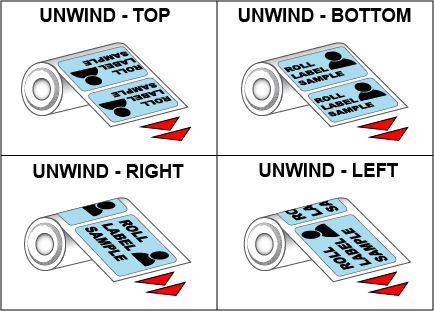
What does “unwind direction” mean?
Unwind direction describes the orientation in which each label faces as it comes off the roll. The correct direction is especially important for machine-applied labels.
Artwork & White Ink
Preparing production-ready files
How should I set up artwork, bleed, and safety?
Use the template for the exact size ordered. Bleed extends .1875 inch beyond the cut line, and the safety area is .1875 inch inside the cut line. Confirm final dimensions before uploading and keep raster images at 300 dpi or higher.
How do I use white ink on Clear or Metallic Silver labels?
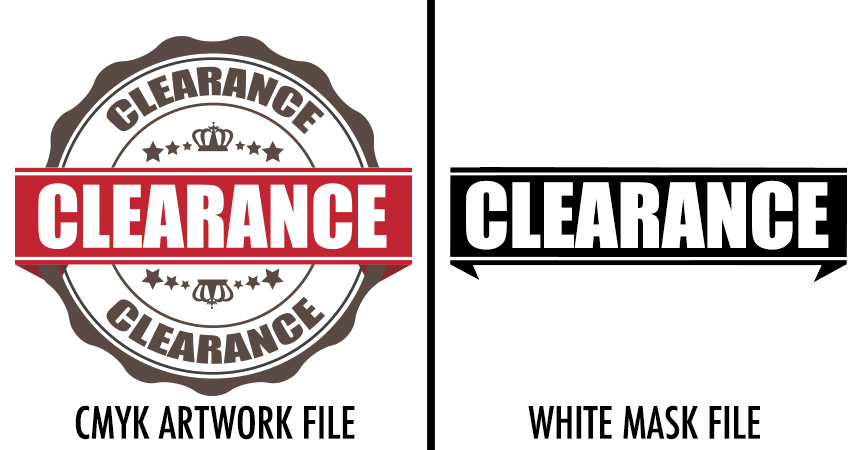
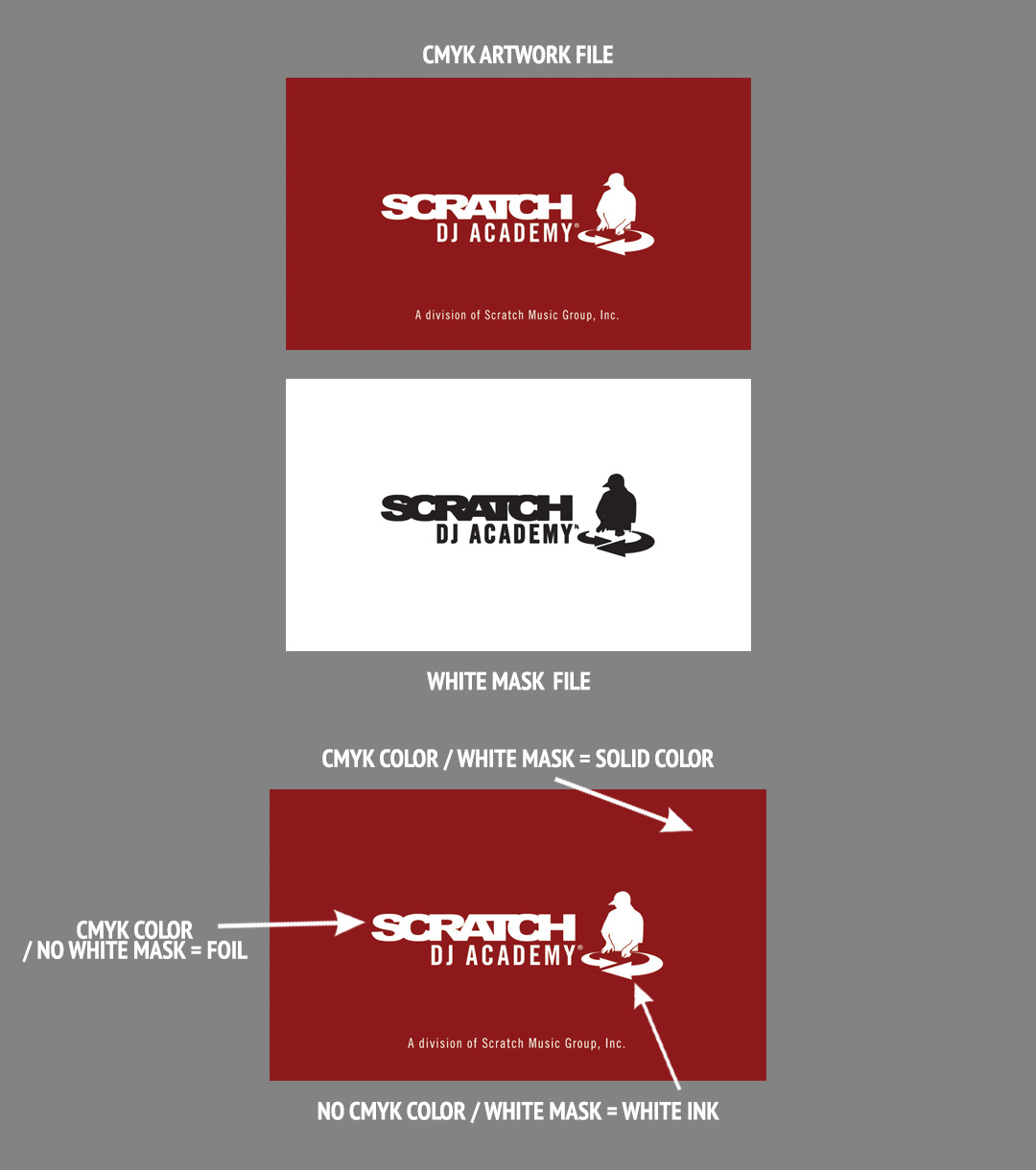
White ink can make selected areas opaque on Clear BOPP or cover the metallic surface beneath solid colors. Supply a separate White Mask at the same final size as the color artwork. Black vector shapes indicate where white ink will print.
White Mask files must be vector artwork saved as EPS or PDF.
When is a White Mask file required?
A separate White Mask is required when you select the 5-color option with white ink. Color with no mask lets the clear or metallic material influence the result. Color with a mask prints opaque. A mask with no color prints white.
How can I reduce white-ink registration issues?
Where CMYK artwork overlaps the White Mask, add a CMYK stroke approximately 1–2 pixels larger than the underlying white area. This helps conceal small alignment variations.
What is the minimum font size for metallic silver labels?
For optimal readability and production results, use type that is at least 8 points.
Print Quality
What to expect from production
Will the print quality look like offset printing?
Roll-label printing produces high-quality results, though it may differ slightly from offset printing. Use 300 dpi or higher images, the correct template, and the specified bleed and safety areas for the strongest result.